Monday, 31 August 2015

Riddle 3

For this riddle, I need you to use the following to create a true mathematical equation.

2  3  4  5  +  =

You may only use each of those once, and it must be true. I am sure some of you are thinking, well what about:
2 + 5 = 3 + 4
But we cannot do this, because we are only allowed to use "+" once. You may combine the numbers, so take the "2" and the "3" and make "23". 

Again, it is a fun riddle, so try and solve it yourself. Do not Google it, have fun with it. 

I will be publishing the answer on Thursday. If you come up with a solution to this before then, keep it to yourself and let me know on Thursday. 

Answer to Riddle 2

The answer to the second riddle is as follows:
I would put my straight line on the '+' sign, making it a 4. This gives me a sum of 545 + 5 = 550, which is true. 

Again, congratulation to Ebony for solving this one. 

Volume of 3D shapes

Today we had a look at calculating the volume of 3D shapes. The general formula for finding the volume of a shape is:

Volume = Area of a Face x Depth (or Height)
or more generally, V = A x D

Now we know how to calculate the area of basic shapes, using the formulas in this table:


We can use these formulas to calculate the area of the face of our 3D shape. When we pick which face to calculate, we need to pick the face that has a constant profile throughout the shape. We need to pick the face so that if we were to cut the shape and take a cross section, the face would be the same dimensions, no matter where we cut it.

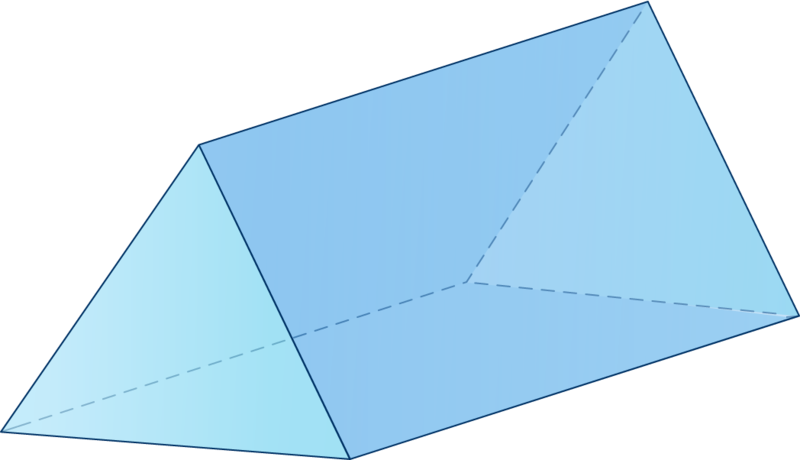
For example, take the following prism.

If we wanted to find the volume of this, we would pick the triangle as our face, because at any point along this prism, we will always have that triangular cross section. We would not pick one of the rectangular faces, because they are not a constant cross section throughout the shape. 
Once we know the area of the triangular face, we simply multiply this by the depth of the prism and we will have the volume. 

Another example could be this pentagonal prism:


We would pick the pentagonal face as our face to use, since at any point along the shape it will still have this as a cross section. Again, once we have the area of this face, we can then multiply it by the depth of the prism and get the volume. 

So for example, find the volume of the following prism: 


First, we will find the area of the face of this prism. In this case, we will use the from face. This is a rectangle with dimensions of 10cm and 4 cm. The area of this is: 
A = 10cm x 4cm 
A = 40cm square

Now that we have the area of the face, we can simply multiply this by the depth of the shape. In this case it is 17cm deep, so we get: 

V = 40cm square x 17cm
V = 680 cubic centimeters. 

Our units for volume are cubed. For example we may have cubic millimeters, cubic centimeters, cubic meters, cubic kilometers, etc. These are written as mm3, cm3, m3, km3 , etc

One last important point is that generally when we talk about volume in the 'real world' we would use the units of milliliters (mL) or liters (L). To convert between our units that we calculate in (i.e. cubic centimeters) and these 'real world' units, we use the following conversion: 

So if a prism has a volume of 45 cubic centimeters, we know it also has a volume of 45mL. 

It is also important to remember that 1L is 1000mL. 

I have uploaded a worksheet into the "Worksheets" tab, so work through that. I need that finished by Thursday's lesson, because we will use Thursday's lesson as a revision lesson for a test coming up. 

As always, if you have any questions comment on this post, or email or chat to me in person. 


Thursday, 27 August 2015

Riddle number 2

I have another riddle for you. For this one you need the following equation:


The riddle is: Add one straight line to this equation to make it true. 

Just one rule for this one, you cannot put a line through the equals sign, to make it "not equal". 

If you come up with an answer before Tuesday's lesson, let me know. Do not tell anyone else, let them try and solve it for themselves. 

Same as last time, do not try and Google the answer. That is not the point of these riddles. They are just meant to be a little bit of fun, so try and solve it. If you can't, don't stress. I will reveal the answer on Tuesday. 

Areas of Composite Shapes

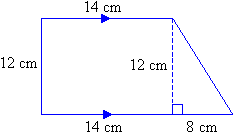
Today we still looked at areas, however we were looking at the area of composite shapes. A composite shape is an irregular shape that is made up of 2 or more regular shapes stuck together (or cut out). For example:
This is a composite shape, because it is made of 2 regular shapes. It has a rectangle with a triangle stuck to the right hand side of it. We know how to find the area of a rectangle and we also know how to find the area of a triangle, so to find the total area of this shape, we find the areas of the 2 regular shapes and add these together. 

So working this out, the area of a rectangle is length times width, so the area of this rectangle is       12 x 14 = 168 centimeters square. The area of a triangle is (base times height) divided by 2, so the area of this triangle is (8 x 12)/2 = 48 centimeters square. So the total area of this shape would simply be the area of the triangle plus the area of the rectangle, which would be 48 + 168 = 216 centimeters square. 

We do have some more complicated shapes. For example, we may have: 
The easiest way to do this one is to break it into 3 rectangles, and find the area of these three rectangles, then add the areas together. I would break it up like so: 
Now we need to find the area of each of the rectangles. 
First we will look at rectangle 1: The are of this one will simply be 12 x 4 = 48 meters square. 

Now looking at rectangle 2: This one is a little more complicated. We are told one of the side lengths, but we don't know the other. We can work this out however. We know the whole left hand side is 12m, and we know that there is 4m above rectangle 2, and 5m below it. So this means that the total side length must be 12 - 4 - 5 = 3m. So we can now work out the area of this rectangle. It would be     5 x 3 = 15 meters square. 

Finally rectangle 3: This one is a little easier. We know the height is 12m and the width is 3m so the area will be 12 x 3 = 36 meters square. 

Now that we know all the area of all of our rectangles, we can find the area of the whole shape. This will be 48 + 15 + 36 = 99 meters square. 

You should now be able to work through the rest of the worksheet on area. Try and have all of this finished by Tuesday. Remember to do all of the questions on this sheet. 

As always, feel free to comment on here if you have any questions, or email or chat to me in person. 


Riddle Answer

The answer to the riddle involved thinking a little outside the box. If you use the number 5 three times with a plus sign you can make it equal to 60. You would do it like so:

Congratulations to Ebony for getting the answer.  Well done!

Wednesday, 26 August 2015

Riddle

On a side note, I did give the students in the class a riddle. If I have the following:
In essence I have 3 identical numbers (20) and a plus sign (+) and I have made it equal 60. I want you to find me a sum that uses 3 different identical numbers (so not 20) and a single plus sign (+) and make it also equal to 60. I will reveal the answer in class tomorrow, so if you can come up with a solution by then, let me know before the start of class. 
Do not try and Google the answer, that would just be cheating yourself! Have a bit of fun with it, and if you can't see an answer don't stress too much. 
There may be a prize in it for anyone who gets the answer before class on Friday 27/08/2015 (i.e. before 10am)